New research from Syracuse University suggests that audiences increasingly judge credibility by the quality of reporting, transparency and accountability. The findings offer lessons for traditional newsrooms and the growing independent media industry.
Nearly two-thirds of Americans say they trust a well-known independent news creator as much as an established professional journalist or major news organization when it comes to political information, according to a new Syracuse University study that challenges longstanding assumptions about how audiences evaluate news.
The findings, released October 8 by Syracuse’s Center for the Creator Economy, suggest that professional credentials and institutional recognition may carry less weight with audiences than the quality of reporting and a journalist’s willingness to acknowledge mistakes.
For traditional news organizations confronting declining public confidence, the research offers a revealing look at what audiences increasingly value. It also raises questions about the professional resources independent journalists need as they take on a larger role in informing the public.
At a glance: Syracuse found that 61% of surveyed adults expressed comparable trust in prominent independent news creators and professional journalists on political topics. Another 67% said doing the reporting matters more than formal journalism credentials, while 86% said publicly correcting mistakes increases their trust in independent creators. The findings point to the importance of accountability and direct audience relationships.
Independent News Creators Are Challenging Traditional Measures of Credibility
The Syracuse findings come from a survey of 1,001 U.S. adults conducted through the online research platform Prolific. The university described the sample as demographically representative. The survey examined how Americans evaluate political news, independent creators, professional journalists and established media organizations.
The results suggest that audiences are increasingly willing to extend credibility to individuals operating outside traditional newsroom structures.
61% of respondents said they trust a well-known independent news creator as much as a well-known professional journalist or major news organization on political topics. Two-thirds placed greater importance on the reporting itself than on formal journalism credentials.
Those findings come with qualifications. Syracuse also found that 79% of respondents believe there is a meaningful distinction between independent news creators and journalists. When asked whether they trusted professional journalists more overall, 41% agreed, 35% disagreed and approximately one-quarter were neutral.
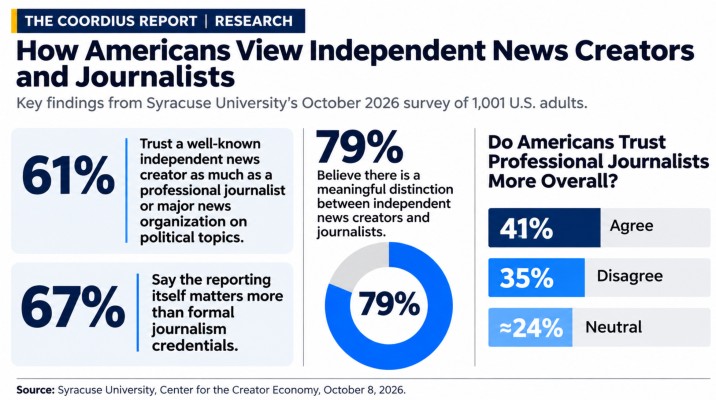
The findings establish substantial trust parity in a specific comparison. They do not establish a universal preference for independent creators.
Political affiliation and news consumption habits also influenced responses. Republicans reported greater confidence in independent news creators than political independents did, while Democrats expressed greater confidence in professional journalists and established news organizations. Respondents who frequently encountered news through social media were more likely to consider independent creators credible.
The results reflect a media environment in which audiences have more choices about whose reporting they consume and how they assess its reliability.
Why Are Audiences Placing Greater Value on Accountability?
One of the strongest findings in the Syracuse research concerns how journalists and creators respond when they make mistakes.
An overwhelming 86% of respondents said their trust in independent news creators increases when those creators publicly correct errors.
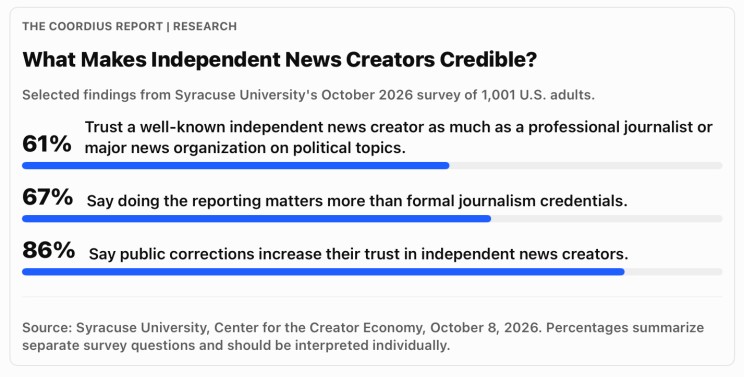
That result offers a useful measure of what accountability means to audiences. A visible correction allows people to see whether someone takes responsibility for their reporting, explains what went wrong and provides accurate information.
The finding also suggests that practices long associated with professional journalism remain central to credibility, regardless of where the work is published.
A separate study released in April by the Center for News, Technology & Innovation (CNTI) examined how independent information providers establish trust with their audiences. Researchers interviewed 26 U.S.-based creators, including former journalists, science communicators, subject-matter specialists and community information providers.
They identified two recurring approaches to credibility: demonstrating authority through sourcing, transparency and professional experience, and developing authentic relationships through personal voice and direct audience engagement.
Participants described sharing supporting documents, explaining their reporting processes and responding to questions from their communities. Many also discussed the importance of presenting themselves as recognizable individuals whose interests and experiences were relevant to their audiences.
The researchers cautioned that their qualitative interviews could not establish how frequently these practices occur across the broader creator economy. The findings nevertheless provide insight into how some independent information providers approach their responsibilities.
They also identify an area where traditional news organizations may have opportunities to reconsider longstanding practices.
What Can Traditional Newsrooms Learn From Independent Creators?
Established news organizations have invested heavily in professional production standards, editorial oversight and recognizable institutional brands. Those resources remain valuable, particularly for complicated investigations, live coverage and reporting that requires substantial coordination.
A polished presentation alone, however, cannot establish a personal connection with audiences.
Independent creators often communicate through formats that allow viewers and readers to become familiar with the individuals responsible for the work. They answer questions directly, explain why certain stories matter to them and sometimes invite audiences into the reporting process.
The Center for News, Technology & Innovation found that independent information providers frequently combined reporting with responsibilities traditionally assigned to separate audience engagement departments. Participants described responding to direct messages, conducting polls, attending community events and using audience questions to shape future coverage.
That interaction can help audiences understand who is providing information and how that person’s work connects to their concerns.
It can also create complications. The researchers documented concerns about harassment, personal attacks and the pressures associated with maintaining close relationships with audiences.
Still, the findings raise an important question for traditional media executives: How much of the distance between news organizations and audiences is a consequence of editorial culture rather than public demand?
Allowing journalists to communicate more naturally, explain their reporting decisions and engage directly with communities may help established outlets make their work more accessible. Those approaches can operate alongside verification, independent editorial oversight and established professional standards.
The audience relationship is becoming part of the journalism itself.
Independent Creators Are Becoming a Permanent Part of the News Industry
Additional research suggests that independent news creators have established a significant presence across the broader information market.
The Reuters Institute’s 2026 Digital News Report found that 27% of respondents across 48 surveyed markets received news from individual creators focused primarily on news. That figure rose to 46% when researchers included creators who primarily cover other subjects but sometimes discuss current affairs.
The report found that audiences frequently considered creators more relatable, entertaining and easier to understand than traditional news outlets. Respondents overall continued to rate established news organizations more favorably on trustworthiness and impartiality.
There were important differences among people who actually consumed creator-led news. Those respondents rated creators more favorably across the attributes measured, demonstrating how familiarity and consumption habits can shape perceptions.
Meanwhile, an April 2026 study from the Associated Press-NORC Center for Public Affairs Research and its Media Insight Project partners found that independent creators had become an information source across generations.
The survey of 2,101 Americans ages 13 and older found that 57% received at least some news from influencers or independent creators, including 81% of teenagers.
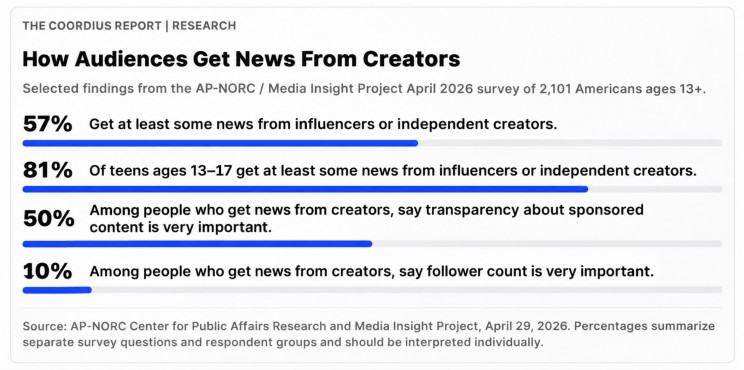
The research also revealed that transparency mattered more to creator-news audiences than popularity. Among those who received news from creators, 50% considered transparency about sponsored content very important to trust, compared with just 10% who placed similar importance on follower counts.
The AP-NORC findings indicated that traditional news organizations continued to enjoy greater overall confidence, particularly local outlets. Younger audiences, however, distributed their confidence more evenly across established and independent sources.
Taken together, the studies suggest that audiences are developing more varied definitions of credibility. They also underscore why comparisons must account for differences in age, platform use, subject matter and the kinds of sources being evaluated.
The Next Challenge Is Supporting Independent Journalism
The expansion of independent news brings questions about the professional resources supporting those who produce it.
Traditional news organizations have historically provided reporters and producers with access to researchers, assignment editors, booking teams, legal resources and established networks of subject-matter experts. Those resources can support more thorough reporting and help journalists manage complicated assignments.
Independent journalists may perform many of those responsibilities themselves, particularly during the early stages of building a publication, podcast or digital news operation.
Finding a qualified medical specialist, verifying an economist’s credentials or identifying a credible researcher can require substantial time and professional judgment. The process becomes more demanding when a creator is also responsible for audience development, production, distribution and revenue.
Some independent journalists bring decades of newsroom experience to their work, while others enter the field through academic, professional or community expertise. Both groups may benefit from more accessible systems for finding qualified sources and managing professional relationships.
For the wider media industry, that creates an opportunity to make reliable expertise and production support available beyond the organizations that have traditionally maintained those resources.
Project C Is Helping Independent Journalists Build Sustainable Businesses
The growing need for professional support has prompted organizations to develop programs specifically for journalists working outside traditional newsrooms.
Among them is Project C, founded by former Vox executive Liz Kelly Nelson , which provides research, training, networking and business development resources to independent journalists.
Project C ’s community includes more than 250 creator journalists building businesses around newsletters, podcasts, video reporting and other forms of independent media. Its Going Solo program helps journalists develop the skills needed to establish sustainable ventures, while its Journalism Creators Startup Lab, developed with the Google News Initiative, provides business training, coaching and ongoing community support.
The Startup Lab’s curriculum covers editorial strategy, audience development, revenue, analytics, safety and trust. The program’s first North American cohort included 20 early-stage creator journalists during the summer of 2026, with a second cohort serving participants in Europe, the Middle East and Africa.
Project C has also contributed to research documenting the independent journalism economy.
In April, the Center for News, Technology & Innovation published US Indie Info Providers: Professionally Diverse, Mission-Driven, Rarely Earning Profit, a study examining the backgrounds, motivations and financial challenges of independent information providers. Project C contributed recruitment, field knowledge and expertise to the research.
Related CNTI research examined how independent creators establish credibility, identifying the importance of transparent sourcing, professional experience and authentic audience relationships.
The work illustrates how the journalism industry’s support systems are beginning to adapt to independent publishing. As journalists increasingly take responsibility for both editorial production and business operations, access to training, professional networks and reliable resources becomes important to their long-term sustainability.
These developments also point to practical challenges that remain. Independent journalists still need to identify qualified experts, verify professional credentials, coordinate interviews and establish dependable working relationships, often without the specialized support available inside larger media organizations.
Improving access to those resources represents another opportunity to strengthen the independent journalism economy.
How Coordius Fits Into the Changing Media Landscape
At Coordius , these developments are central to our thinking about the future of journalism and content creation.
We are developing a platform intended to help journalists and independent creators discover, evaluate and connect with credible experts. Our focus includes professional verification, relevant experience and the practical coordination required to turn an introduction into a productive interview or collaboration.
The Syracuse findings strengthen the case for supporting independent creators as established participants in the information economy. Their audiences are demonstrating that credible reporting can earn trust across different publishing models.
Organizations such as Project C are addressing the training, community and business development needs of independent journalists. Access to trusted expertise and professional collaboration represents another important part of the support those journalists require.
For creators working independently, identifying an appropriate source may involve researching credentials, confirming affiliations, evaluating conflicts of interest and coordinating availability. Each step requires time and judgment, especially when a journalist is also responsible for producing and distributing the finished work.
The same challenges extend to documentary filmmakers, podcasters, educators and other creators producing content that depends on qualified professional expertise.
Coordius’s work is focused on making those connections easier to establish and manage while preserving the independent editorial decisions that responsible reporting requires.
As more individuals take responsibility for producing journalism and evidence-based content, access to reliable professional resources becomes increasingly relevant to the quality and sustainability of their work.
What the Research Means for the Future of Journalism
The studies published this year offer several lessons for traditional newsrooms, independent journalists and organizations developing services for the creator economy.
Audiences continue to value the fundamentals of journalism, including accurate reporting, transparency and accountability. They are also rewarding forms of communication that make the people behind the work more accessible.
For established news organizations, the findings provide a reason to examine how journalists communicate with audiences and whether existing practices create unnecessary distance. More transparent reporting processes and direct engagement could help build stronger relationships.
For independent creators, the research reinforces the importance of documenting sources, correcting mistakes visibly, disclosing relevant interests and establishing expertise through the quality of their work.
For organizations supporting independent journalism, including Project C, the findings underscore the importance of training, community and sustainable business development. For media technology companies, they highlight the growing need for tools and professional resources that help creators carry out the responsibilities that accompany independent publishing.
The Syracuse study is particularly revealing because it demonstrates that audiences can recognize distinctions between independent creators and professional journalists while still expressing comparable confidence in their reporting on political issues.
That suggests public trust is becoming less dependent on a single professional identity or publishing institution.
The implications extend beyond journalism to documentary filmmaking, educational media, podcasts and other forms of content that rely on qualified sources and responsible storytelling.
As the news industry continues to change, the organizations and individuals best positioned to maintain audience confidence will be those that demonstrate their credibility through consistent practice.
The institutions producing journalism are evolving. The public’s expectations of accuracy, transparency and accountability remain central to whether that journalism earns trust.
The Coordius Report is a weekly publication examining journalism, media trust, the creator economy and the business of credible expertise. Learn more at https://coordius.com.
Sources and Further Reading
- Syracuse University, Center for the Creator Economy. October 8, 2026. YouTube Overtakes TV as Top Source of Political News, Study Finds. Survey of 1,001 U.S. adults examining trust in independent news creators and professional journalists.
- Center for News, Technology & Innovation. April 13, 2026. Bridging Humanity and Rigor. Qualitative research on how independent information providers establish authority and authenticity.
- Reuters Institute for the Study of Journalism. June 2026. Digital News Report 2026, Overview and Key Findings. International research on news consumption, creators and public trust.
- Associated Press-NORC Center for Public Affairs Research. April 29, 2026. The Evolving News Landscape: Comparing Media Habits and Trust Between Teens and Adults. Survey examining news consumption and trust among Americans ages 13 and older.
- Project C. About Project C. Organizational background, founder information and details of its independent journalism community.
- Project C and Google News Initiative. Journalism Creators Startup Lab. Program curriculum, training model and 2026 cohort information.
- Project C. Research and Press. Documentation of Project C’s contribution to CNTI research on independent information providers.